
How Advanced Awning and Zip Screen Production Machines Are Transforming Outdoor Shading Manufacturing
The outdoor shading market has grown rapidly in recent years, fueled by rising demand for patio covers, retractable awnings, and zip screens in both residential and commercial spaces. According to Grand View Research, the global awning market is projected to reach $14.5 billion by 2030, growing at a CAGR of 6.2% from 2023 to 2030. This surge has put pressure on manufacturers to improve production efficiency, reduce costs, and maintain high-quality standards. Modern awning and zip screen production machines have become essential tools to meet these challenges.
---
Understanding Awning and Zip Screen Production Machines
Awning and zip screen production machines are specialized industrial equipment designed for automated fabrication of outdoor shading products. Unlike manual processes, these machines handle multiple production steps, including:
Precision fabric cutting
Sewing and heat welding
Roller assembly and motorization
Quality control and finishing
For example, automated fabric cutting machines can reduce material waste by up to 20%, while high-speed sewing systems can complete tasks that previously took hours in just minutes.
Main Features of Modern Machines
1. Automated Fabric Cutting
Modern CNC fabric cutters offer high precision and minimal waste. Textile World reports that automated cutters can reduce labor-intensive measuring and cutting errors by 15–20%.
2. High-Speed Sewing and Heat Welding
Automated sewing and welding units improve seam strength and uniformity. Data from Industrial Fabric Solutions 2022 shows a 30–40% increase in stitching efficiency compared to manual methods.
3. Motorized Roller Systems
For retractable awnings and zip screens, consistent tension is crucial. Motorized rolling systems ensure smooth operation and longevity, reducing maintenance costs.
4. Smart Control Panels
Touchscreen interfaces and IoT-enabled monitoring allow real-time tracking of production speed, machine health, and material usage. Automation World 2023 notes that IoT integration can cut downtime by up to 25%.
---
Benefits of Modern Production Machines
1. Increased Efficiency
Manual manufacturing of a medium-sized awning can take 6–8 hours per unit, whereas automated machines can reduce production time to 2–3 hours, effectively doubling or tripling daily output.
2. Reduced Labor Costs
Automation decreases dependence on skilled labor. A mid-sized factory can save 20–30% in annual labor costs by adopting modern machinery, according to Manufacturing Today 2022.
3. Consistent Product Quality
Precision-cut fabric, uniform seams, and controlled roller tension ensure durable, long-lasting products that withstand wind, rain, and sun exposure.
4. Waste Reduction
Automated cutting and sewing minimize material waste, saving medium-scale manufacturers $5,000–$10,000 per year, depending on production volume.
5. Flexible Production
Modern machines allow quick adjustments for different product sizes, fabrics, and designs, enabling manufacturers to respond swiftly to market trends without costly downtime.
---
Real-World Example
European Manufacturer Case Study
A German awning manufacturer upgraded its production line with automated cutting, sewing, and rolling machines in 2022. The results within a year:
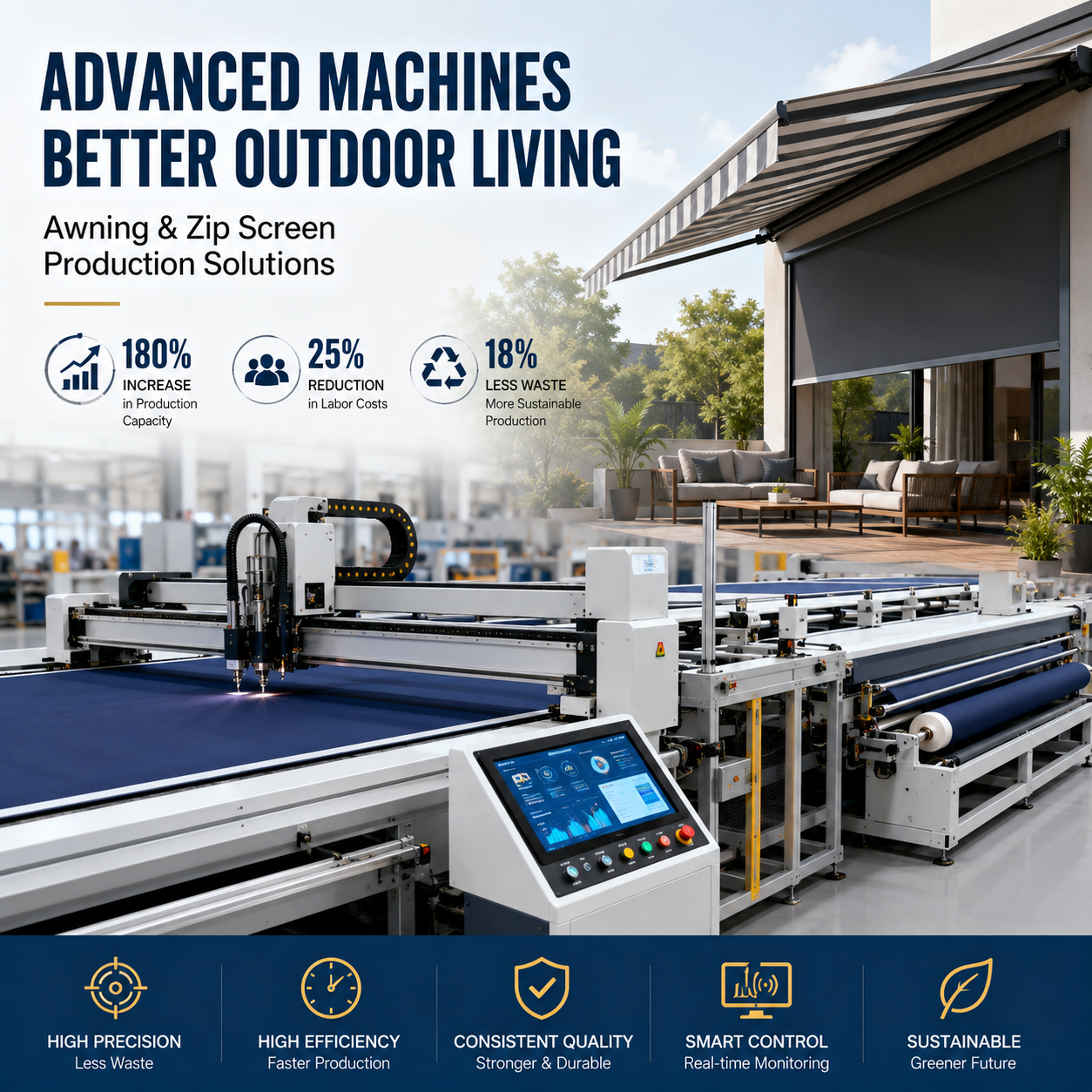
Production capacity increased by 180%
Labor costs decreased by 25%
Material waste dropped by 18%
Seam-related complaints reduced by 90%
This demonstrates that automation delivers both quantifiable ROI and enhanced product quality.
---
Trends Shaping Outdoor Shading Machinery
1. Robotics and Automation
Robotic arms are increasingly used for sewing, fabric handling, and assembly, improving precision and reducing repetitive strain injuries.
2. Energy Efficiency
Energy-efficient motors and optimized heating systems reduce electricity consumption by 15–20%, according to Energy Efficient Manufacturing 2023.
3. Smart Manufacturing Integration
IoT-enabled machines enable predictive maintenance, real-time monitoring, and ERP integration, improving production planning and reducing downtime.
4. Sustainability
Minimizing fabric waste and using eco-friendly materials aligns with global sustainability trends, which are increasingly demanded by consumers and regulators.
---
Tips for Manufacturers Investing in New Machines
Evaluate ROI: Consider labor savings, efficiency gains, and waste reduction.
Compatibility: Ensure machines suit your product sizes and fabric types.
Training: Employees need guidance to operate and maintain machinery efficiently.
Scalability: Choose modular machines that can adapt to future product lines.
---
Conclusion
Modern awning and zip screen production machines are revolutionizing the outdoor shading manufacturing industry. They provide tangible benefits: higher productivity, lower labor costs, consistent quality, and reduced waste. With the global awning market projected to expand steadily, manufacturers who invest in advanced machinery today are positioning themselves for long-term success and competitiveness.
By integrating automation, IoT monitoring, and sustainable practices, businesses can not only meet growing demand but also stand out in quality and efficiency in an increasingly competitive market.


 EN
EN