
 EN
Why Squareness and Edge Sealing Make or Break Shade Production
Anyone running a busy window covering workroom knows that cutting shade fabric is nowhere near as forgiving as cutting standard apparel textiles. When a customer hangs a three-meter-wide sunscreen shade across a floor-to-ceiling glass wall, even a two-millimeter diagonal skew across the roll causes the fabric to telescope sideways as it winds up the aluminum tube. Within a week of operation, the skewed edge rubs against the mounting brackets, frays the yarns, and triggers a costly warranty return or replacement order.
Mastering industrial roller blinds cutting comes down to controlling fabric tension before the blade ever touches the roll and locking the synthetic yarns in place the instant the cut finishes. Modern window shade textiles are engineered composites rather than simple woven cloth. Fiberglass-core solar screens coated in PVC, multi-pass acrylic blackout fabrics, and delicate dual-layer zebra blinds all react differently under mechanical shear. Treating every roll on the rack with the same blade speed and clamping pressure guarantees scorched edges on light colors or loose threads unraveling along the vertical hem.
According to window covering quality guidelines referenced by the Window Covering Manufacturers Association and ISO 30061 dimensional flatness standards, commercial shade panels must maintain diagonal squareness tolerances within 1.5 millimeters over a three-meter drop to prevent tracking failure. Hitting those tight numbers shift after shift requires rigid flatbed tables, synchronized servo drives, and the right cutting head for each polymer blend.
Comparing Ultrasonic, Crush Cut, and Rotary Blade Technologies
Picking the right cutting method is the single biggest technical decision on the shop floor. A basic motorized rotary round knife slices quickly through natural cotton blends or heavy canvas awnings, yet it struggles with loose-weave polyester zebra fabrics where severed weft threads immediately slip out of the weave. Laser cutters melt synthetic edges shut, but the thermal heat affected zone often leaves a yellow or brown burn mark along white blackout coatings and fills the workshop with acrid PVC fumes when processing vinyl-coated fiberglass.
Ultrasonic cutting solves the fraying and scorching dilemma by vibrating a titanium horn at twenty to forty kilohertz. Instead of burning the material with external heat, high-frequency mechanical vibration generates localized molecular friction right at the microscopic contact point of the blade bevel. The thermoplastic yarns melt and fuse together internally without discoloring the top acrylic foam coating or leaving a thick, brittle bead that causes bumps when the blind rolls up.
| Cutting Method | Edge Sealing Quality | Best Suited Shade Materials | Yellowing or Smoke Risk | Consumable Maintenance |
|---|---|---|---|---|
| Motorized Rotary Knife | None (mechanical shear only) | Heavy canvas, coated fiberglass, natural weaves | Zero | Frequent blade sharpening |
| Pneumatic Crush Cut | Low to Moderate (pressure pinch) | Non-woven spunbond, stiff polyester | Zero | Anvil roller resurfacing |
| CO2 Laser Cutter | High (thermal melt bead) | Intricate decorative cutouts, pure polyester | High on PVC and white coatings | Lens cleaning and exhaust filters |
| Ultrasonic Cutting Head | Excellent (micro-fused soft edge) | Zebra blinds, sheer sunscreen, thermoplastic blackout | Zero | Periodic sonotrode horn tuning |
Because ultrasonic energy seals only the immediate synthetic fibers without building up a raised plastic lip, rolls stack flat on the winding tube without telescoping. Most modern automated cutting tables mount both an ultrasonic module and a high-speed tungsten steel rotary blade on a dual-head gantry, allowing operators to switch modes straight from the touchscreen depending on the job ticket.
What Happened When a Commercial Shade Workroom Upgraded Its Cutting Line
A real-world look at how table rigidity and blade selection impact daily output comes from a mid-sized commercial window treatment fabricator supplying hospitality and office building projects. For years, the shop relied on two manual pull-out cutting tables fitted with basic single-rail rotary end cutters. Whenever the production schedule called for two-thousand-piece runs of five percent openness PVC-coated fiberglass sunscreen and sheer-to-solid zebra shades, the bottleneck became painfully obvious. Two workers had to pull each roll by hand against a tape measure, align the weft against a framing square, and trim frayed threads with hand scissors before moving panels to the hem-bar welding station.
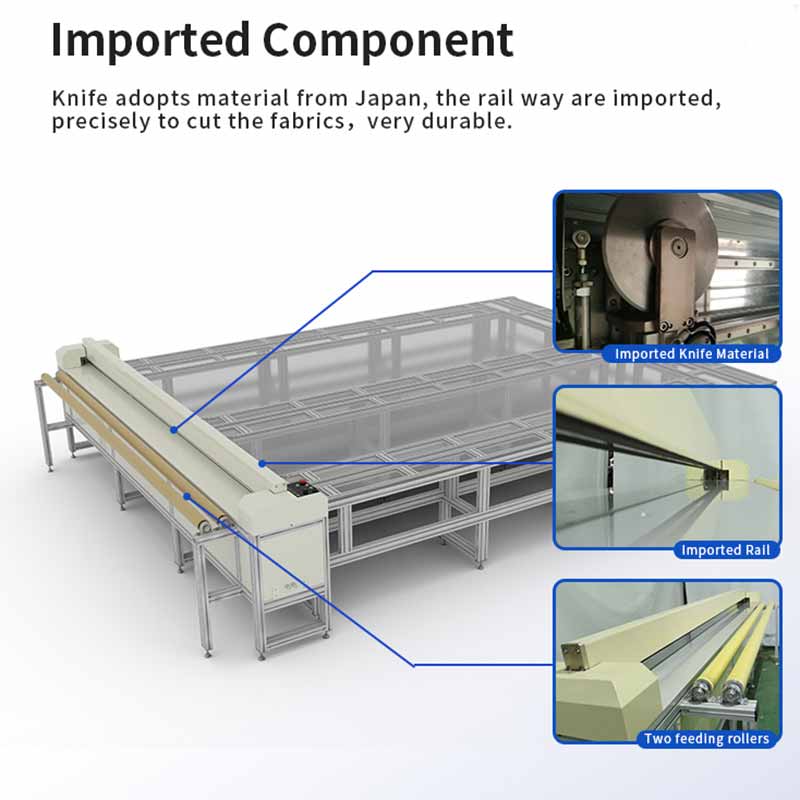
During a seasonal capacity upgrade, the plant manager replaced the manual benches with a four-meter-wide automated flatbed cutting machine featuring pneumatic cradle feed rollers, infrared edge alignment sensors, and an interchangeable ultrasonic-and-rotary tool head. Instead of pulling heavy rolls by hand, the motorized cradle unwound the fabric tension-free across a vacuum-assisted felt conveyor surface. Over the following six months, fabric waste caused by off-square diagonal cuts dropped from nearly seven percent down to under one percent. Better yet, the ultrasonic cutter sealed the delicate sheer bands on zebra blinds cleanly in a single pass, freeing two full-time trimmers to move over to final assembly and hardware packaging.
Controlling Weft Bowing and Tension on Wide Span Flatbed Tables
Even the sharpest tungsten carbide blade or tuned ultrasonic horn will produce a crooked blind if the fabric sits under uneven tension on the table. When wide rolls of solar screen or blackout material sit in warehouse racks during humid summer months, the cardboard core can sag slightly, introducing a subtle curve across the horizontal weft threads known as bowing or skewing. If an operator feeds that roll straight under the clamping beam without letting the material relax, the fabric snaps back like a stretched rubber band the moment the blade finishes its cross-cut.
Seasoned cutting operators keep wide-span panels dead square by sticking to three practical shop floor habits:
-
Run the motorized unwinding cradle with a dancer bar or loop sensor so a loose slack loop hangs freely between the roll and the table entry, removing all winding tension before the fabric hits the cutting surface.
-
Check the pneumatic clamping beam pressure across the full width of the bridge, setting just enough downward force to hold slick blackout coatings stationary without crushing delicate foam backings.
-
Adjust the ultrasonic generator amplitude and gantry travel speed whenever switching fabric weights, since driving an ultrasonic horn too slowly across thin polyester sheer will melt a jagged edge, while moving too fast skips the edge seal entirely.
It is also worth being honest about where ultrasonic heads hit their physical limits. Pure fiberglass yarns and natural linen fibers do not melt under ultrasonic vibration because they are not thermoplastics. When cutting fiberglass-core solar screens, the ultrasonic vibration seals the outer vinyl jacket, but the inner glass filaments still rely on the physical sharpness of the bevel edge. Keeping a stock of fresh, honed carbide tips and switching to the mechanical rotary cutter for non-thermoplastic textiles prevents crushed edges and premature horn wear.
Choosing Reliable Automated Equipment and Long Term Technical Support
Keeping a fabric fabrication line running profitably year-round comes down to mechanical stability beneath the tabletop. A cutting bridge spanning three tofive meters experiences strong acceleration forces every time the carriage reverses direction. If the machine frame is built from lightweight bolted aluminum profiles rather than stress-relieved welded steel tubing, vibration works its way into the linear guide rails within a year, throwing off diagonal accuracy and chewing through linear bearings.
Sourcing cutting and welding machinery from an established equipment builder like Dongguan Ridong Intelligent Equipment Co., Ltd. gives shade manufacturers a solid mechanical foundation built for heavy industrial shifts. With nearly two decades of specialization in automated curtain and roller blind machinery, Ridong engineers heavy-duty cutting tables, ultrasonic slitting systems, and precision fabric joining equipment backed by strict component quality control and responsive technical support. Whether upgrading a growing custom blind studio or outfitting a high-volume export factory, partnering with Ridong helps production teams keep tolerances tight, edges clean, and delivery schedules firmly on track.
Table of Contents
- Why Squareness and Edge Sealing Make or Break Shade Production
- Comparing Ultrasonic, Crush Cut, and Rotary Blade Technologies
- What Happened When a Commercial Shade Workroom Upgraded Its Cutting Line
- Controlling Weft Bowing and Tension on Wide Span Flatbed Tables
- Choosing Reliable Automated Equipment and Long Term Technical Support


