
 EN
EN
When Manual Cutting Starts Costing More Than It Saves
Walk into any mid-sized curtain workshop that's still cutting fabric by hand, and the scene tends to look the same. A few experienced operators crouched over long tables, measuring tapes stretched across rolls of fabric, marking lines with chalk, then running scissors or straight knives along the marks. It's been done this way for decades. But the economics have shifted.
A 2025 market analysis placed the global curtain cutting machine market at roughly $133 million, with projections reaching around $179 million by 2032 at a compound annual growth rate of 4.5%. That growth isn't driven by novelty. It's driven by shop floors that have run the numbers and realized manual cutting—once the default—has become a bottleneck that's harder to ignore with each passing quarter.
The real question isn't whether automatic curtain cutting machines exist. It's whether a given operation has crossed the threshold where manual methods no longer make business sense.
The Hidden Costs That Don't Show Up on a P&L
Labor cost per cut is the obvious metric. But the less obvious costs are the ones that accumulate quietly. Rework from inaccurate cuts. Fabric waste from mis-measured panels. The time spent double-checking measurements because one operator's "close enough" isn't the same as another's.
One production manager at a Southern California shading manufacturer shared a telling figure during a facility walk-through last year. Their team had been tracking rework rates across two identical production lines—one using manual cutting, the other running an automated system that had been installed six months prior. The manual line was generating roughly four times the rework of the automated line. Not because the operators were unskilled. Because human error accumulates differently than machine error. A tape measure read wrong by 2 millimeters on a 3-meter cut leads to a panel that doesn't fit. That panel gets recut. The fabric gets scrapped. The clock resets.
What Automatic Cutting Actually Changes in the Workflow
The transition from manual to automatic cutting isn't simply about replacing scissors with a motorized blade. It's about restructuring how orders move through the shop.
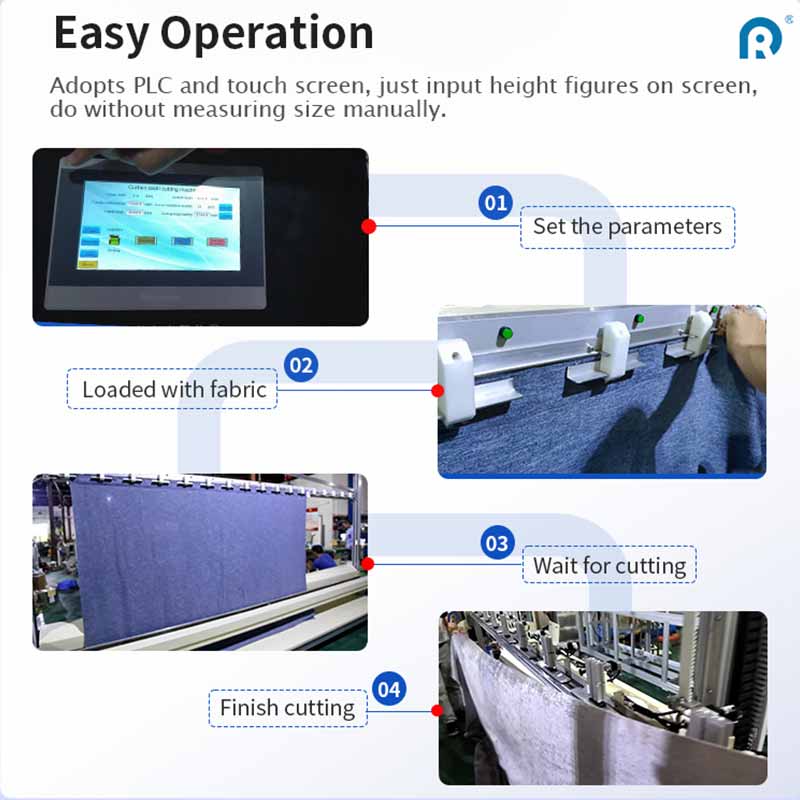
Manual cutting typically involves six to eight distinct steps: measuring, marking, layout planning, cutting, verifying dimensions, and stacking. Each step introduces variables. Each step is an opportunity for deviation. An automatic curtain cutting machine compresses that workflow into four or five steps, merging measurement verification and layout directly into the cutting sequence.
The practical difference shows up in order throughput and in the consistency of the output. A shop running multiple manual cutting stations might process a certain number of panels per shift. But those panels won't all be identical—not exactly. The same order run through an automatic system produces panels that match within tolerances that manual methods simply cannot sustain over a full shift.
Reading the Signs: When to Make the Shift
Not every shop needs automatic cutting right away. The decision point usually appears when three conditions converge.
First, order volume reaches a level where cutting becomes the constraining operation. If cutters are working overtime while sewing stations wait for material, that's a signal.
Second, product variety increases to the point where setup time starts eating into productive hours. Automatic systems handle changeovers differently than manual stations—the setup is digital rather than physical.
Third, and perhaps most critically, when consistency becomes a competitive requirement rather than a nice-to-have. Customers who order multiple windows expect panels that match. Manual cutting can deliver that, but only with extraordinary care and constant verification.
A 2025 industry report noted that fully integrated automatic cutting systems are increasingly being adopted for end-to-end workflow integration, whereas standalone automatic units continue to serve specific cutting tasks. The distinction matters. Some operations benefit most from a dedicated cutting station that feeds downstream assembly. Others need the full integration.
The Limitations That Matter
Automatic cutting isn't a universal solution. It works best with fabrics that have consistent properties—uniform thickness, predictable behavior under the cutting mechanism. Highly textured or heavily coated materials can present challenges that require specific tooling configurations.
There's also the question of order mix. A shop that primarily runs small-batch custom orders with frequent fabric changes may find that the setup time on an automatic machine doesn't pencil out compared to a skilled manual cutter who can switch fabrics in seconds. The economics tilt toward automation as batch sizes grow and fabric changes become less frequent.
What to Look For Before Committing
Before investing, it pays to run a simple audit. Track every cut for a week. Note the time per panel, the rework rate, the fabric waste percentage. Compare that against what a properly specified automatic curtain cutting machine could deliver in the same environment.
The market data suggests the industry is moving decisively toward automation. But that doesn't mean every shop should move at the same pace. The right time to identify the need is when the numbers—not the marketing—make the case.
For operations that have reached that point, manufacturers like Ridong have been supplying cutting solutions to the sunshade industry for over twenty years, with equipment deployed across more than eighty countries. Their experience across diverse production environments offers a useful reference point for shops evaluating their own transition.


