
 EN
EN
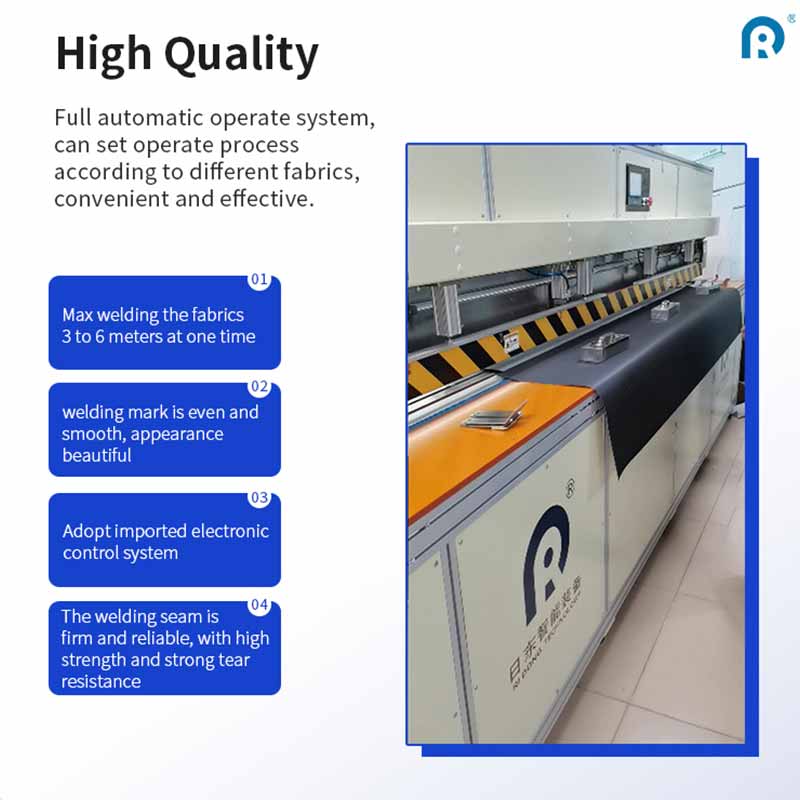
The Question That Keeps Coming Up in Shading Workshops
Every few months, someone in a roller blind production meeting asks the same question: "Why are we still sewing these seams?" It's a fair question. Sewing has been the default method for joining roller blind fabrics for as long as anyone can remember. Hem the edges, attach the hardware, ship the order. The workflow has worked well enough for decades.
But something changed in the last five years. Orders got more complex. Lead times got shorter. And the pool of skilled sewing operators kept shrinking.
The alternative—roller blind welding—has been around for years, but it's only recently that the technology has matured to the point where it's a genuine option for mainstream production rather than a niche solution for specialty applications.
How the Two Methods Actually Compare
The fundamental difference comes down to how the materials are joined. Traditional sewing uses thread to mechanically stitch two layers of fabric together. The strength of the seam depends on the thread, the stitch density, and the integrity of the fabric around each needle hole.
Roller blind welding uses controlled heat and pressure to fuse the fabric layers at a molecular level. No thread. No needle holes. No weak points where the fabric has been perforated. The resulting joint is homogeneous—essentially as strong as the base material itself.
| Aspect | Traditional Sewing | Roller Blind Welding |
|---|---|---|
| Seam strength | Limited by thread and needle holes | Matches base fabric strength |
| Water resistance | Needle holes create potential leak paths | Fully sealed, watertight seam |
| Visual appearance | Visible stitch line | Clean, nearly invisible joint |
| Operator dependency | High - skill determines quality | Lower - machine parameters control outcome |
| Rework rate | Variable, often 15-20% range | Significantly reduced |
The numbers tell a clear story. In one mid-sized operation that switched from sewing to welding, the rework rate dropped so sharply that even the production manager was surprised.
Where Welding Delivers the Biggest Gains
The most immediate benefit shows up in seam performance. Welded seams don't have needle holes, which means they don't leak. For outdoor shading applications—zip screens, exterior roller blinds, awning fabrics—this is a non-negotiable requirement. Water ingress through a stitched seam doesn't just look bad; it degrades the fabric over time and can lead to premature failure.
There's also the consistency factor. Sewing quality varies with the operator's fatigue level, the tension settings on the machine, and the condition of the needle. Welding, by contrast, is controlled by machine parameters that don't drift over a shift. Once the temperature, pressure, and dwell time are set correctly, every seam comes out the same.
The global welding machinery market, valued at roughly $19.8 billion in 2025, is projected to reach $29.6 billion by 2032. That growth reflects a broader industrial trend: manufacturers across sectors are moving away from mechanical fastening methods toward fusion-based joining techniques that offer better consistency and lower lifecycle costs.
The Things Welding Doesn't Do Well
Honesty matters here. Welding isn't the right choice for every fabric or every application.
Certain coated fabrics don't weld well. The coating can interfere with the fusion process, resulting in weak seams. Similarly, fabrics with high synthetic content generally weld better than natural fibers, which tend to scorch rather than fuse.
There's also the question of equipment investment. A roller blind welding machine represents a different capital outlay than a sewing station. For operations that already have a full sewing room, the transition requires both equipment purchase and operator training.
The suitability question also depends on product type. For roller blinds that will be used indoors and won't see moisture, the waterproof advantage of welding matters less. For outdoor products, it's a different calculation.
A Real-World Comparison from the Shop Floor
A workshop in eastern China that produces both indoor and outdoor roller blinds ran a side-by-side comparison last year. They took the same fabric, same order quantity, and ran half through their sewing line and half through a newly installed welding machine.
The sewing line required three experienced operators. The welding line required one operator. The sewing line produced seams that varied in quality depending on which operator was at the station. The welding line produced identical seams across every panel. The rework from the sewing line was consistently higher—not dramatically so, but enough to affect the bottom line on tight-margin orders.
The takeaway wasn't that sewing is obsolete. It was that for certain products—particularly outdoor shading where weather resistance matters—welding delivered a better result with less operator dependency.
Making the Call for Your Operation
The decision between sewing and welding comes down to product mix, fabric types, and quality requirements. For shops that primarily produce indoor roller blinds with standard fabrics, sewing remains a perfectly viable method. For those making outdoor shades, zip screens, or any product where seam integrity and weather resistance are critical, welding offers clear advantages that are hard to ignore.
The technology has advanced enough that roller blind welding is no longer experimental. It's a proven production method with measurable benefits. The question is whether those benefits align with a given operation's specific needs.
Companies like Ridong have been manufacturing welding equipment for the sunshade industry for over two decades, with installations across more than eighty countries. Their experience across diverse production environments provides a useful reference for shops weighing the welding option.


