
 EN
A Few Millimeters Is Not a Rounding Error on a Roller Blind
Cutting roller blind fabric looks like a straightforward operation until a finished unit comes back from a job site with a light gap along the window frame or a bottom bar that refuses to sit square. The cut itself was maybe two or three millimeters off. On a piece of fabric, that sounds trivial. In an assembled roller blind, it is not.
The fabric panel has to align with the tube, the bottom bar, and the mounting brackets within a tolerance band that the rest of the hardware was designed around. A cut that drifts wide pushes the fabric edge into the bracket path. A cut that runs short leaves a light halo at the perimeter. Neither failure shows up at the cutting table. Both show up after installation, when the unit is already packaged, shipped, and hung. One blind manufacturer in Southeast Asia tracked returns across a production quarter and found that dimensional inconsistencies traced back to the cutting stage accounted for a meaningful share of field complaints, even though the fabric itself passed inspection. The cutting error was small. The downstream cost was not.
That is the practical argument for moving roller blind fabric cutting onto a CNC platform. Not because manual cutting cannot produce a good panel. A skilled operator can absolutely nail one cut. The problem is nailing the same cut on the four hundredth panel of the week, after lunch, with a fabric roll that has a little more stretch than the last one.
What CNC Actually Replaces in the Cut Sequence
The term CNC gets used loosely in window covering equipment marketing. On a roller blind cutting table, it means the motion of the cutting head is governed by a controller that has a digital map of where the cut should go, and the machine holds that path across every cycle.
Manual cutting of roller blind fabric involves a sequence of discrete physical judgments. The operator pulls fabric to a mark, checks the tape, adjusts for the fabric’s tendency to skew, positions a straight edge, and drives a blade or a rotary cutter along the line. Every one of those steps is a place where a small error can enter, and the errors do not necessarily cancel out. They accumulate across a shift.
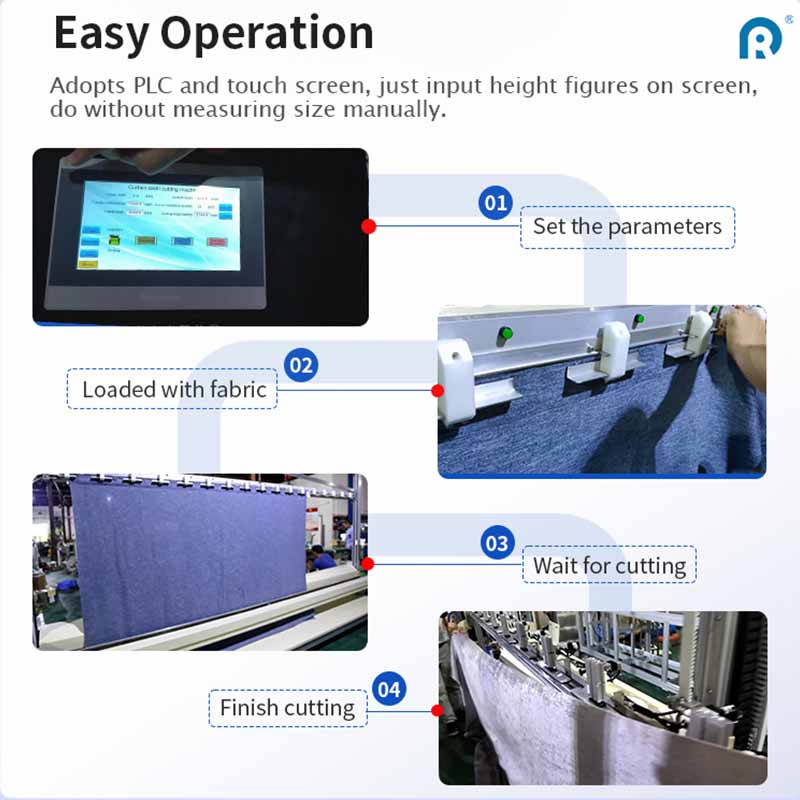
CNC cutting collapses measurement, positioning, and blade motion into a single controlled sequence. The fabric is fed to a reference point, the controller calculates the cut path from the order data, and the cutting head executes that path without a human hand in the middle of the geometry. Repeatability stops being a function of operator fatigue and becomes a machine specification.
The gap between the two approaches is not incremental. Published comparisons put skilled manual cutting on long roller blind panels in the range of plus or minus two to three millimeters over a three meter length. A CNC cutting table holds dimensions closer to plus or minus 0.1 millimeter. That order-of-magnitude difference is what changes whether downstream assembly fights the fabric or receives it.
The Variables a Controller Can Hold That Hands Cannot
Three things make roller blind fabric harder to cut consistently than a stable woven upholstery fabric, and each one maps to a specific control problem.
Fabric skew is the first. A roll that has been wound under tension does not always unwind straight. The weave can track slightly off-axis, and a manual cutter compensates by eye. A CNC table with a fabric edge sensor or a trained vision reference can detect the actual edge position and adjust the cut path to match the material as it sits, not as the roll label says it should sit.
Feed tension is the second. Roller blind fabrics, especially PVC-coated fiberglass and polyester composites, behave differently depending on how much tension they are under during the cut. Too much tension and the fabric stretches, then relaxes after the cut, leaving a panel that is dimensionally short. Too little and the fabric wrinkles under the cutting head, producing a wavy edge. Servo-driven feed systems hold tension within a programmed band, which removes the operator’s daily judgment call about how hard to pull.
Blade force and acceleration are the third. Pushing a blade through a coated fabric at a constant speed is not the same as pushing it through at a speed that varies with hand pressure. Variations in blade force show up as edge defects that may not be visible until the fabric is rolled and unrolled a few hundred times in the field.
Where the Edge Quality Problem Lives, and Why It Outlasts the Cut
A clean cut dimension is only half of what the cutting stage contributes to a roller blind. The other half is the condition of the cut edge, and this is where roller blind fabrics punish generic cutting approaches.
PVC-coated fiberglass, a common substrate for blackout and screen roller shades, presents a specific failure mode. The PVC coating is supposed to encapsulate the fiberglass yarns at the cut edge. In practice, some glass strands can escape the coating during cutting and remain exposed. Those strands fray over time, and the fray becomes visible on a dark fabric as white fuzz along the edge. Lutron, a major shade systems manufacturer, documents this as an inherent characteristic of PVC-coated fiberglass roller shade fabric, not a manufacturing defect in the fabric itself. The cutting process determines whether that inherent tendency gets worse or stays under control.
This is why the choice of cutting head is not a commodity decision. Different automatic cutting technologies interact with roller blind fabrics in different ways:
| Cutting method | Edge behavior on roller blind fabric | Best fit | Where it struggles |
|---|---|---|---|
| Rotary blade | Mechanical severing; clean on stable wovens, but does not seal thermoplastic yarns | Uncoated woven blends and stable constructions that do not fray aggressively | Coated fiberglass and loose synthetic weaves; exposed strands can fray later |
| Ultrasonic | High-frequency vibration melts and fuses thermoplastic content at the edge in one pass | Polyester, acrylic, PVC-coated fabrics, and any synthetic blend prone to fraying | Natural fiber-dominant fabrics; slower feed rates than rotary |
| Laser | Localized thermal sealing | Thin thermoplastic single-ply work | Heat-affected zone, edge discoloration on light fabrics, higher maintenance load |
| Crush cut | Pressure-based separation with a sealed edge | Materials that need a fused edge without ultrasonic equipment | Thicker composites and high-volume runs where blade wear accelerates |
The practical takeaway is not that one method wins. It is that a shop running mostly blackout coated fabric and a shop running mostly natural-blend drapery panels are not solving the same edge problem. A CNC platform that only supports one cutting head is a partial solution for a mixed order book.
A Production Floor Where the Rework Data Made the Case
A window covering factory in Southeast Asia was running three manual cutting stations feeding a roller blind assembly line. The quality team was not complaining about cutting speed. The complaint was dimensional rework and edge rejection at final inspection. Panels were arriving at assembly with inconsistent widths, and the finishing station was spending time trimming or remaking edges that had already passed the cutting table.
The shift to a CNC cutting table did not eliminate the finishing step. It changed what the finishing step had to do. Once cut widths and edge conditions arrived within a predictable band, the assembly team stopped compensating for the cut and started building the blind. Rework at the cutting-to-assembly handoff dropped substantially, and the operator skill profile shifted. The most experienced cutters moved into setup, fabric inspection, and program management roles, while the machine took over the repetitive positioning work.
The factory did not reduce headcount. It reassigned the judgment work and let the machine carry the repetition. That is a more realistic outcome than the labor-replacement story that equipment brochures tend to tell.
Fabric Utilization Is a Cutting Room Problem Before It Is a Purchasing Problem
Roller blind manufacturing generates trim loss at the cutting stage, and the way panels are arranged on the fabric roll determines how much of that loss is recoverable. The problem has been studied formally as a two-dimensional cutting stock problem in made-to-measure roller blind production, with the specific complication that fabric rolls can contain small defects that must be steered into the waste area rather than into a finished panel.
A CNC cutting table with nesting software can optimize panel placement around known defects and order dimensions. Matic, a cutting equipment manufacturer, reports fabric utilization around 91 percent with an optimized cutting workflow on roller blind production, and cites customer feedback of 15 to 30 percent fabric savings compared with unoptimized manual layouts. Those savings come from layout intelligence, not from a faster blade.
The limitation is worth stating plainly. Nesting gains depend on order mix. A shop cutting long runs of a few standard widths has less layout freedom than a shop cutting a high variety of made-to-measure sizes. The software also cannot rescue a cutting table that lacks the positional accuracy to execute the nested layout without drifting. Layout optimization and cut accuracy are a pair. One without the other leaves money on the floor.
Where CNC Makes Sense, and Where a Smaller Format Still Wins
A CNC roller blind cutting platform is a capital commitment, and the honest recommendation depends on order profile more than on shop size in square meters.
For a fabricator running a steady mix of made-to-measure roller blinds with coated and synthetic fabrics, the combination of dimensional repeatability and edge sealing addresses the two failure modes that generate the most downstream cost. For a workshop cutting a narrow range of sizes from stable woven fabric at low daily volume, a semi-automatic table with a rotary head can cover the requirement without the control complexity.
The variables that actually drive the payback are not the headline cutting speed. They are rework rate at assembly, edge rejection at final inspection, and fabric utilization across the roll. A cutting platform that improves those three lines in the production data is doing its job, even if the speed number on the spec sheet is unremarkable.
Dongguan Ridong Intelligent Equipment Co., Ltd. approaches roller blind cutting from the machine-building side, with CNC cutting platforms configured around servo-driven motion, selectable tool heads, and fabric feed systems designed to hold tension without stretching roll goods. The engineering starting point tends to be the fabric mix and the assembly tolerance, not a single cutting speed claim. For fabricators working through a cutting upgrade, that is the right conversation to have first.
Table of Contents
- A Few Millimeters Is Not a Rounding Error on a Roller Blind
- What CNC Actually Replaces in the Cut Sequence
- The Variables a Controller Can Hold That Hands Cannot
- Where the Edge Quality Problem Lives, and Why It Outlasts the Cut
- A Production Floor Where the Rework Data Made the Case
- Fabric Utilization Is a Cutting Room Problem Before It Is a Purchasing Problem
- Where CNC Makes Sense, and Where a Smaller Format Still Wins


