
 EN
EN
The Scalability Ceiling That Nobody Talks About
Scaling a curtain manufacturing operation sounds straightforward on paper—buy more machines, hire more people, push more product out the door. In practice, the cutting station often becomes the bottleneck that strangles growth before it ever really starts. A mid-sized workshop might handle 200 panels a day with two manual cutting tables and four operators. Push that to 400 panels, and suddenly the cutting floor turns into chaos—misaligned stacks, inconsistent measurements, fabric waste piling up, and rework rates climbing past acceptable levels.
The global window covering market was valued at roughly $14.4 billion in 2024 and is projected to hit $22.7 billion by 2033, growing at about 5.2% annually. That growth doesn't distribute evenly across the supply chain. Shops that can't scale their cutting operations efficiently will watch that opportunity walk right past them to competitors who figured out the production math.
What Scalability Actually Means on the Cutting Floor
Scalability in industrial curtain cutting isn't just about processing more fabric per hour. That's the oversimplified version that equipment salespeople love to pitch. Real scalability means the ability to handle variety without sacrificing speed, to absorb volume spikes without doubling the headcount, and to maintain quality consistency whether the order is for fifty identical panels or five hundred custom-sized ones.
A properly designed cutting system scales across three dimensions: throughput volume, material diversity, and order complexity. The first dimension is obvious—more panels per shift. The second matters when a shop takes on everything from lightweight sheers to heavyweight blackout fabrics, each requiring different cutting parameters. The third dimension kicks in when orders shift from bulk runs of identical sizes to high-mix, low-volume custom work, which is increasingly where the market is heading.
The Hidden Costs of Manual Cutting at Scale
Manual cutting has a place in the industry, no question about it. For small-batch custom work or prototyping, a skilled cutter with a straight knife and a good table can produce excellent results. But scale changes the math entirely.
Consider what happens when a shop scales from two cutting stations to six without changing the underlying process. Labor costs don't just multiply—they compound. Training new cutters takes time, and quality varies widely between experienced hands and newcomers. Material waste from measurement errors compounds across every station. A study from the International Textile Machinery Association found that automated cutting systems can achieve 98% pattern repeat accuracy across multiple production cycles, compared to significantly lower consistency with manual methods.
Here's the reality that gets overlooked: manual cutting doesn't scale linearly. Double the output, and the error rate doesn't stay flat—it climbs. More cuts mean more opportunities for mistakes, more fabric lost to mis-measurement, and more rework eating into margins that were already thin.
A Case from the Field: The Southern Chemical Plant Retrofit
During a retrofit project at a chemical plant in southern China, the facility's in-house curtain maintenance shop faced an unusual challenge. The plant operated across multiple buildings with non-standard window dimensions—nothing matched from one wing to the next. They were producing replacement curtains in batches of thirty to forty panels, each with unique height and width specifications.
The existing setup used a manual cutting table with a straight knife. One operator could cut about fifteen panels per shift, and the error rate ran around 8%—meaning roughly one out of every twelve panels needed recutting. That didn't sound catastrophic until you multiplied it across the plant's 200-plus windows that required replacement on a rolling schedule.
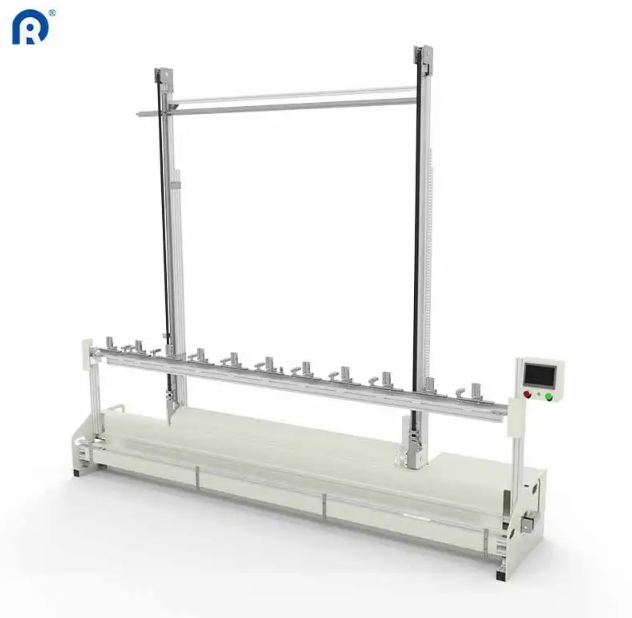
The team swapped in an automated vertical cutting machine with programmable height settings. The operator simply entered the dimensions for each batch, and the machine handled the rest. Output jumped to forty-five panels per shift with the same headcount, and the error rate dropped below 1%. The plant reduced its curtain replacement backlog from six weeks to ten days without adding a single person to the maintenance team.
Technology Options That Enable Real Growth
Not every cutting technology serves scalability the same way. The choice matters more than most shop owners realize.
Blade-based systems remain the workhorse for high-volume production. They handle thick materials like blackout curtains efficiently and keep operating costs low over long production runs. The trade-off: blades dull over time and require replacement, and they don't seal fabric edges, which means separate finishing steps for materials that fray.
Laser cutters, particularly CO2 systems, excel with delicate fabrics like silk or lace. Research from the Textile Research Journal (2023) indicates laser cutting can reduce edge fraying by roughly 85% compared to conventional blades. The precision tolerance reaches about 0.1mm, which matters for pattern matching on high-end goods. But laser systems carry higher upfront costs and require more maintenance.
Ultrasonic cutting vibrates at high frequencies to cut and seal synthetic materials simultaneously. This eliminates post-cut finishing for many synthetic blends, but the technology doesn't perform as well on natural fibers or heavily layered stacks.
CNC-controlled systems deliver the repeatability that scalability demands. Modern CNC curtain cutters maintain accuracy within roughly 0.5mm across eight-hour production shifts and can process around 120 meters of fabric per hour—about three times faster than manual methods.
The Economics of Scaling Up
The investment case for scalable cutting equipment hinges on a few key numbers that manufacturers should run before signing any purchase orders.
| Cost Factor | Manual Cutting (per 1,000 panels) | Automated CNC Cutting (per 1,000 panels) |
|---|---|---|
| Direct labor | 40–50 operator hours | 8–12 operator hours |
| Fabric waste | 8–12% of material | 3–5% of material |
| Rework rate | 6–10% of panels | 1–2% of panels |
| Training overhead | High (ongoing) | Low (one-time) |
A poorly optimized manual cutting process can waste 15–20% of fabric per lay, while an automated CNC system with optimized marker planning routinely achieves waste rates below 10%. That difference alone—5 to 10 percentage points of material savings—often covers the equipment investment within two to three years for shops running at moderate scale.
Making the Transition Without Breaking Production
Switching from manual to automated cutting isn't a flip-the-switch operation. The transition requires planning, and the smartest shops phase it in rather than going all-in overnight.
Start with the highest-volume, most repetitive SKUs. Those are the easiest to program and deliver the fastest ROI. Let the manual stations handle the oddball custom orders while the automated system builds a track record on the bread-and-butter work. Once the operators are comfortable and the machine has proven its reliability, shift more of the mix over.
The other piece that often gets neglected: data. Automated systems generate production data that manual stations never could—cut times, material usage, error logs. That data becomes the foundation for continuous improvement. Shops that treat the cutting machine as a data source rather than just a tool tend to see scalability gains that go far beyond the initial throughput bump.
Ridong has been manufacturing curtain cutting equipment since 2007, with installations across more than 100 countries. Their experience across diverse factory environments—from small workshops to large-scale production facilities—provides a practical perspective on what works when scaling curtain cutting operations.
Table of Contents
- The Scalability Ceiling That Nobody Talks About
- What Scalability Actually Means on the Cutting Floor
- The Hidden Costs of Manual Cutting at Scale
- A Case from the Field: The Southern Chemical Plant Retrofit
- Technology Options That Enable Real Growth
- The Economics of Scaling Up
- Making the Transition Without Breaking Production